How can science and technology activities be made engaging and relevant in primary education?
In this blog I will talking about why science and technology is important in education and why children need to learn and realistically enjoy being involved with the subjects for their future selves.
Children in primary education should receive an enjoyable and experimental education. Science and technology can be made fun and engaging to allow children to get the most out of the subject as they can to benefit them. Our society is filled with science and technology, it’s almost impossible to live a day without being involved with science and technology and everyone needs at least a basic level of understanding of them, including our children in education settings (Osborne & Dillon, 2008
Children being un-interested in science and technology and other subjects for that matter, can be due to various explanations. A report published by Green (2016) suggest that during secondary school interest in science and math’s drops by 53% for girls and 42% for boys. This coincides with the curriculum’s focus moving from the bigger picture into the more abstract, microscopic world. Ensuring science remains as relevant to our older students as it was for them at primary school is important in order to stop them from being turned off the subject (Green, 2016). Statistics show that 87% of parents feel children would be more engaged with science lessons if teaching used the most advanced technology (Open Access Government, 2018). According to research, attitudes toward science and technology are formed before the age of 14 (Osborne & Dillon, 2008in primary school (Turner & Ireson, 2010). However, there tends to be a decline of interest from students and sometimes alternatively more positive attitudes that appear during secondary education (Murphy & Beggs, 2005).
Professor
Graham Donaldson’s (2015) report ‘Successful
Futures’, indicates that the curriculum should be based on six Areas of
Learning and Experience as organisers for the entire age range from 3 to 16.
Included within the new curriculum being implemented in the proposed Areas of
Learning and Experiences is science and technology (Donaldson, 2015). Science
involves acquiring knowledge through observation and experimentation. Technology applies scientific
knowledge in practical ways. (Donaldson, 2015). ‘The relationship between
science, technology and industrial success in modern societies is complex’
(Wolpert, 1992, p. 34).
‘The
(problem solving) approach can be used to help children understand the manmade
world through practical problem-solving, involving using and discovering
scientific concepts and skills in conjunction with design-and-make activities’
(Engineering Council, SCSST 1985, p. 13).They can do this by having students look, listen, touch, smell, and taste
(i.e., observe); encouraging them to ask more questions; having them try to
predict what will happen; having them collect and use information from
different sources that can range from rocks, sticks, and beetles to numbers, tables,
and diagrams; stimulating them to seek and apply creative new applications for
particular constructs; having them talk about their experiences and ideas using
their own words; and having them examine those patterns that stand out in
observations and measurements (Murphy, 2003).
This
Area of Learning and Experience capitalises on children and young people’s
curiosity about our natural, physical world and universe though investigating,
understanding, and explaining. They learn to generate and test ideas, gather
evidence, make observations, carry out practical investigations, and
communicate with others. They also learn how through computer science, the
horizons of what is possible can be extended beyond our current imagination
(Donaldson, 2015, p. 50).
Children
and young people will also have opportunities to learn how technology is used
to design products that improve the quality of human life and to apply their
scientific and other knowledge to practical purposes and challenges. For
schools, this means providing children and young people with rich opportunities
to develop technological skills, knowledge, understanding and attributes
through designing and developing products and systems. They will be able to
explore the impact of technology on society and the environment (Donaldson,
2015, p.50)
Phillips (2014) says that most
children love technology. It has become such an important part of our everyday
lives that most people cannot imagine being without their mobile phone. Some
might argue that children are not interested in science, this is not true at
all. They might not enjoy science lessons at school, but that’s something very
different. Young children often say that science is one of their favourite
subjects in their early years of education. Something changes later on when
teachers introduce more complex concepts. They move away from ‘fun’
experiments to teaching theory, something that seems less relevant to the real
world (Phillips, 2014).
There are many ways in which you can make science and technology engaging for
primary school children, there are several simple but creative activities you
can do. Trying out
the hands-on experiment is the best way to learn science. Teachers must come up
with interesting ways to teach science in the classroom to make it fun (WCaty, 2017).
These experiments are good
examples of how to engage children in science and technology classes:

·
Milk
art (Science Fun, 2018)
·
Building
Bridges
·
Making
Slime
By
implementing these kinds of experiments with children in educational
experiences and lessons, allows them to gain knowledge and understanding of
what the technology and science behind the experiments are, they will grow to
enjoy science and technology and that will help them to develop their passion
for the subject that is being implemented into the new curriculum.
In a
recent lecture for AOLE, my lecturer conducted a number of different experiments
where he had some of the students to help him complete them. The examples of experiments
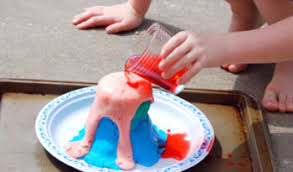
that he showed us were the ruler drop, the exploding volcano, Mentos and coke
and making slime. While being involved with the lecture, I felt that I was
engaged and interested in what was happening with each of the experiments and I
found myself wanting to see more of each experiment and learn how to conduct
them myself. My favourite experiment out
of these was the volcano experiment because of the effect that it has when the
reaction happens inside the ‘volcano’ and the frothy product that ejects out of
the top. I think that children would have so much fun making these and you
could make it a science project for children to create a volcano during arts
and crafts lessons, and then they could use their own volcanoes that they have
made in school in order to complete the experiments within their science and
technology lessons.
References
Donaldson,
G. (2015) Successful Futures: Independent Review of Curriculum and
Assessment Arrangements in Wales. Welsh Government: Wales
Engineering Council, SCSST (1985)
Problem Solving: Science and Technology in Primary Schools. London: Routledge
Green, C. (2015) How to make Science relevant to students. Available: https://eic.rsc.org/ideas/how-to-make-science-relevant-to-students/2010041.article (Accessed: 20 March 2019)
Murphy, C. (2003) ‘Literature review in primary
science and ICT. Graduate School of Education, Queens University Belfast.’ A Report for NESTA Future lab, 32, pp.
1-36
C.J.2005LondonWelcome
Trust
Open Access Government (2018) UK schools urged to do more to engage
children in science lessons. Available: https://www.openaccessgovernment.org/engage-children-in-science-lessons/51726/ (Accessed: 20 March 2019)
J.J.2008LondonThe Nuffield Foundation
J.J.2008LondonThe Nuffield Foundation
Phillips, R. (2014) How
can teachers inspire children in a science class? Available: https://www.britishcouncil.org/voices-magazine/how-can-teachers-inspire-children-science-class (Accessed: 27
March 2019)
Science Fun (2018) Milk
Art. Available: http://www.sciencefun.org/kidszone/experiments/milk-art/ (Accessed: 31 March 2019)
S.G.2010Fifteen pupils’ positive approach to primary school science: When does it
decline?'119141
Wcaty (2017) 7 Ways to make science
fun in the classroom. Available: https://wcaty.org/7-ways-to-make-science-fun-in-the-classroom/ (Accessed: 31 March 2019)
Wolpert, L (1992) The
Unnatural Nature of Science. London: Faber
Youtube
(2016) DIY Exploding Volcano Easy Kids
Science Experiment. Available: https://www.youtube.com/watch?v=fn2bzrN3V8A (Accessed: 26 March 2019)
Youtube
(2016) Mentos and Coke Experiment - Easy Science with Kids-
Summer Ideas for Kids. Available: https://www.youtube.com/watch?v=TVTSLk0Q4fA (Accessed: 26 March 2019)

Comments
Post a Comment